
Aether Insights: Turning Ghost Towers Into Gold

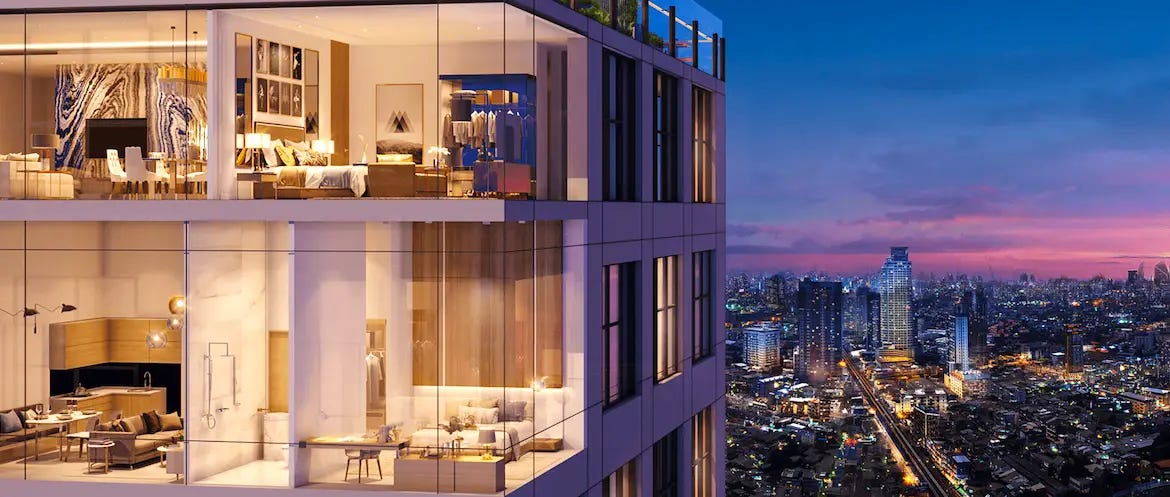
The office tower used to symbolize power. Today, it mostly symbolizes bad timing. Across the United States and the United Kingdom, the same glass boxes that once represented corporate ambition now sit half-dark, half-leased, and fully overlevered. Yet inside these balance-sheet fossils lies the most interesting real-estate arbitrage of the decade: converting obsolete office stock into branded residential property.
If remote work killed the office, housing scarcity might just resurrect it. That tension creates the core of the trade. Investors are not buying offices anymore. They are buying optionality, the ability to transform something unloved into something scarce.
The setup: the death of the desk economy
Class C and D office buildings, mostly built from the 1950s through the 1980s, are now stranded assets. They lack open layouts, modern HVAC, and flexible wiring. Corporate tenants want hybrid campuses and ESG-certified amenities. What they do not want is a fluorescent maze with low ceilings and dated elevators.
But those same inefficiencies become features in residential conversion. Older structures tend to have solid bones, generous ceiling heights, and strong floor plates. Developers can buy them at discounts of 40-60% to replacement cost and retrofit them into apartments or condos faster than they could start from scratch. A full gut renovation costs roughly $250–350 per sq ft, often 25–30% cheaper than ground-up development. The spread between the old valuation and the new yield is pure arbitrage.
The trade: add a brand, add a multiple
The conversion math improves exponentially once branding enters the picture. A Four Seasons-branded residence is not just an apartment; it is a status symbol with a concierge. Marriott, Ritz-Carlton, and even non-hospitality names from fashion and automotive are licensing their brands to residential towers.
Why it works:
Pricing premium: Branded residences routinely command 15–25 percent higher sale prices than comparable luxury apartments.
Sales velocity: Buyers trust the brand’s design, operations, and service standards, so units sell faster.
Operational efficiency: The hospitality partner handles service delivery, from valet to private dining, reducing management risk.
Investor appeal: The branding fees (often 4–6 percent of revenue) are more than offset by the uplift in valuation and liquidity.
Branding turns an adaptive reuse project into a lifestyle product, one that attracts global capital and tenants willing to pay for identity as much as square footage.
Dallas and the new skyline logic
Dallas is the laboratory for this play. The metro’s population will exceed 11 million by 2045, tech employment is booming, and office vacancies are north of 22%. Those two statistics are not unrelated. As knowledge workers relocate, they want walkable, amenity-rich neighborhoods. They do not want another suburban cul-de-sac.
Converting underused office stock downtown into branded rental or condo units solves both problems: it fills dark towers and meets real housing demand. Similar dynamics are unfolding in other “secondary” tech metros, Austin, Tampa, Denver, and even Huntsville, each with a mix of obsolete office inventory and growing professional populations.
How to position for the upside
Capital stack control
The first money earned is the best risk-adjusted return. Investors who can structure senior or mezzanine financing for adaptive-reuse developers capture equity-like upside with debt-like security.Hospitality joint ventures
Partner directly with hotel brands expanding into residential licensing. Many want U.S. exposure but prefer local development partners who understand zoning and capital markets.Tax-advantaged redevelopment
Cities like Dallas and Denver are offering tax credits, low-interest loans, and density bonuses for conversions that add housing. These incentives can shift project IRRs by several hundred basis points.Tech-adjacent markets
Focus on metros with rising tech employment and limited housing supply. The underlying demographic tailwind matters more than short-term rate cycles.The ESG retrofit angle
Adaptive reuse has one of the lowest embodied-carbon footprints in real estate. That matters for institutional capital seeking green mandates. Funds positioning as “carbon-light urban revitalization” vehicles can access cheaper financing.
The fine print
Conversions are not turnkey. Deep floor plates without natural light kill residential feasibility. Zoning and permitting still have slow timelines. Environmental remediation adds cost. But these are solvable problems, not existential ones. The market inefficiency is not about architecture; it is about imagination and capital formation.
The verdict
What looks like decay is really a duration mismatch. Office buildings were financed for a work model that no longer exists. Residential conversions simply reprice them to reality. Layer in brand partnerships and hospitality-grade amenities, and the returns can rival early-stage private equity.
The skyline of the next decade will not be built from scratch. It will be recycled, rebranded, and repriced. Investors who understand that simple fact are not buying empty offices. They are buying the future of cities, one floor plate at a time.
Disclaimer: Aether Insights provides content for informational and educational purposes only and does not constitute financial, investment, tax, or legal advice. All investments involve risk, including the possible loss of principal. Real-estate development and adaptive-reuse projects carry construction, regulatory, and market risks. Past performance is not indicative of future results. Readers should conduct independent due diligence and consult qualified professionals before committing capital.